By demanding recognition of territory it doesn’t control and rejecting any credible oversight of the Zaporizhzhia nuclear plant, Moscow signaled it is not seeking peace but validation — ensuring the Geneva talks remained symbolic rather than substantive.
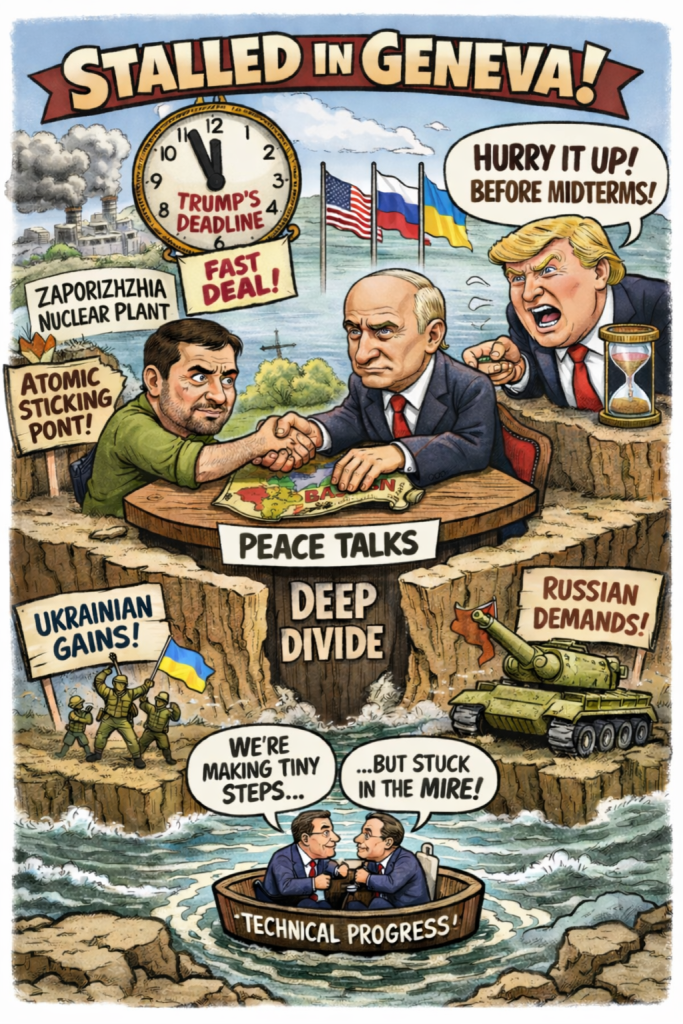
GENEVA — The latest round of U.S.-mediated peace talks between Russia and Ukraine ended much as they began: with cautious handshakes, guarded optimism, and a political gulf so wide that even two days of shuttle diplomacy could not narrow it. For all the choreography of statesmanship on the shores of Lake Geneva, the third round of negotiations concluded with a familiar verdict — progress on technicalities, paralysis on substance.
American envoys described the discussions as “meaningful,” a word that has become diplomatic shorthand for not entirely futile. But the core dispute remains untouched. Russia insists on full control of the Donbas, including territory it has not yet seized. Ukraine refuses to surrender sovereign land, especially under pressure from an ally urging speed over fairness. The result is a negotiation that moves, but does not advance.
A Negotiation Overshadowed by Washington’s Clock
The most destabilizing force in Geneva was not seated at the table. President Donald Trump’s insistence on a “fast deal” — ideally before June 2026 — hung over the talks like a second ceiling. Kyiv has grown increasingly vocal about the pressure, and President Volodymyr Zelenskyy’s unusually blunt public remarks underscored the strain.
“To demand concessions primarily from the invaded nation rather than the aggressor is not fair,” Zelenskyy said, a rare rebuke of the United States from a wartime leader who depends on American support. His warning was not merely political; it was existential. “Emotionally, people will never forgive this,” he added, referring to the prospect of ceding the Donbas. “They will not forgive me, and they will not forgive the United States.”
The message was unmistakable: a rushed peace risks becoming an imposed peace, and an imposed peace risks becoming a broken one.
Russia’s Maximalist Demands and the “Atomic” Sticking Point
If Washington’s timeline complicates diplomacy, Moscow’s demands effectively freeze it. Russia’s delegation, led by Vladimir Medinsky, has not budged from its insistence on full control of Donetsk and Luhansk. This includes areas still under Ukrainian control — a position that transforms negotiation into ratification.
The dispute over the Zaporizhzhia Nuclear Power Plant adds another layer of deadlock. Ukraine’s proposal for a joint U.S.-Ukrainian mandate to operate Europe’s largest nuclear facility was dismissed outright by the Kremlin. For Moscow, the plant is both a bargaining chip and a symbol of territorial permanence. For Kyiv, it is a matter of national safety and international oversight. For negotiators, it is an immovable object.
The result is a diplomatic geometry in which every line leads back to the same impasse: Russia demands recognition of gains it has not secured; Ukraine refuses to legitimize occupation; the United States wants a deal before the political winds shift again.
A Battlefield That Refuses to Stand Still
What made the Geneva stalemate even more striking was the timing. Days before the delegations arrived in Switzerland, Ukrainian forces executed their fastest territorial advance in two and a half years — retaking 78 square miles east of Zaporizhzhia after exploiting a Russian communications breakdown reportedly linked to a Starlink disruption.
The gain was modest in absolute terms but enormous in symbolic weight. It demonstrated that the front lines remain fluid, that Russian control is not inevitable, and that Ukraine retains the capacity to alter the map through force rather than concession.
For Zelenskyy, the advance provides leverage at a moment when he is being asked to compromise. For Putin, it is a reminder that battlefield momentum can still embarrass diplomatic posturing. For American mediators, it complicates the argument that time is running out for Kyiv.
Technical Progress Without Political Movement
Despite the political stalemate, negotiators did inch closer to agreement on a ceasefire monitoring mechanism — a technical framework that would place American and European personnel on the ground in a non‑combat role. It is the kind of incremental progress diplomats highlight when larger breakthroughs remain elusive.
But even this development carries its own contradictions. A monitoring mission presupposes a ceasefire, and a ceasefire presupposes agreement on territorial control. Without clarity on who owns the soil, any pause risks becoming a prelude to renewed fighting.
As the war approaches its fourth anniversary, the diplomats’ “businesslike” tone cannot obscure the structural reality: technical progress cannot substitute for political consensus, and political consensus cannot emerge while one side demands recognition of territory it does not hold.


 Fact-or-Fiction Daily News
Leave a comment