The conflict has exposed a new reality: drones now shape visibility, strategy, and industrial capacity more than traditional firepower — and defense planners across NATO are scrambling to adapt.
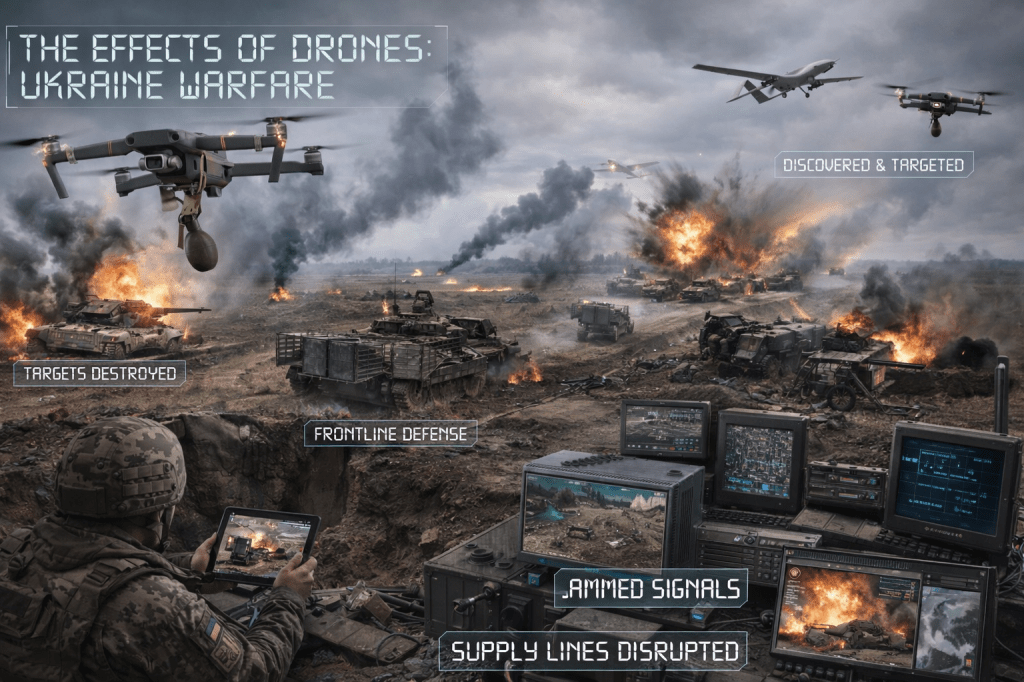
When Russia launched its full-scale invasion of Ukraine in February 2022, few military analysts predicted that a $500 quadcopter would become one of the war’s most consequential weapons. Yet within months, the battlefield looked nothing like what the old playbooks anticipated. Small commercial drones, some originally designed for hobbyists, were being retrofitted with grenades and cameras. Loitering munitions were hunting tanks. Long-range strike drones were reaching deep into Russian territory. What started as battlefield improvisation has since matured into something more significant: a fundamental rethinking of how wars are fought.
Ukraine has become, by necessity, the world’s most active laboratory for drone-dominated warfare. And the lessons being written there — often in real time, often at great human cost — are already reshaping defense planning from Washington to Warsaw.
You Can Run, But You Can’t Hide
Perhaps the most immediate change drones have brought to the battlefield is the end of invisibility. In past conflicts, reconnaissance came in snapshots — a satellite pass, a scouting report, a manned aircraft on a timed mission. Commanders had windows of concealment they could exploit. In Ukraine, those windows have largely closed.
Drones provide cheap, persistent, around-the-clock surveillance, and the effect on tactics has been profound. Armored columns that once depended on speed and mass for protection now face detection within minutes of moving. Artillery crews, long accustomed to firing from fixed positions, have had to become nomadic — relocating constantly to avoid the drone-guided counter-battery fire that follows a spotted position. Even small infantry units operate under the quiet, unsettling assumption that somewhere overhead, something is watching.
The result is a battlefield where knowing how to disappear has become just as valuable as knowing how to shoot.
A Tech Startup War
Both sides have responded to this reality by throwing themselves into a frenetic cycle of innovation that feels less like traditional military procurement and more like a Silicon Valley arms race. Ukraine and Russia are each adapting, counter-adapting, and counter-counter-adapting at a pace that would have seemed implausible a decade ago.
Artificial intelligence is now woven into drone operations — assisting with target recognition, optimizing flight paths, and enabling drones to navigate when GPS is jammed or unavailable. That last capability matters enormously, because electronic warfare has become one of the defining features of this conflict. Russia deploys extensive jamming systems specifically designed to knock Ukrainian drones out of the sky. Ukraine has answered with frequency-hopping communications and onboard AI that allows a drone to complete its mission even after losing its connection to the outside world.
The electronic warfare environment over the front lines is now so saturated that many drones last only minutes before being disabled — which only pushes engineers on both sides to iterate faster.
Then there’s the industrial dimension, which may prove to be the most consequential of all. Ukraine has set an ambition of producing one million drones per year. Russia, facing its own manufacturing constraints, has leaned on partnerships with foreign suppliers to keep pace. But scaling up production is harder than it sounds. Supply chains for critical microelectronics are fragile. Designs have to be modular and standardized to be manufactured quickly. And whatever you build today risks being obsolete tomorrow as the other side figures out how to defeat it. Ukraine has learned, sometimes painfully, that winning the drone war isn’t just about having good ideas — it’s about sustaining an entire industrial ecosystem under the pressure of an active war.
Reaching Behind the Lines
One of the most strategically significant developments has been the use of long-range drones to strike targets deep inside Russia. Ukrainian drones have hit oil refineries, military airbases, and logistics infrastructure hundreds of miles from the front lines — forcing Moscow to spread its air defenses thin and confront the vulnerability of its own territory.
The impacts ripple outward in three directions. Strategically, disrupting supply chains and forcing an adversary to defend a vast rear area is enormously costly. Economically, strikes on refineries and industrial sites affect fuel production and export capacity, turning drones into instruments of financial attrition. And psychologically, perhaps most powerfully, these strikes send a message that distance is no longer a form of protection. For Russian civilians and political leadership alike, the sound of an explosion far from any front line carries its own meaning: nowhere is truly safe.
The West Takes Notes
NATO allies have been watching all of this closely, and they’ve started acting on what they’ve seen. Allied militaries are expanding their drone fleets, investing heavily in counter-drone systems, and working to integrate unmanned platforms into combined-arms doctrine that was written for a very different kind of war. NATO exercises now routinely include simulations of drone swarm attacks — a scenario that would have been considered exotic before 2022.
The United States has moved particularly aggressively. The Pentagon is accelerating development of autonomous systems, loitering munitions, and AI-enabled targeting tools. The U.S. Army’s Replicator Initiative — an effort to field thousands of small, expendable drones rapidly — is a direct acknowledgment of one of Ukraine’s clearest lessons: in this kind of warfare, quantity has a quality all its own.
The New Baseline
What Ukraine has shown the world is that drones are no longer supporting players in modern conflict. They have moved to center stage. They compress the time commanders have to make decisions, strip away traditional advantages like armor and range, and force militaries to adapt at a speed that most bureaucratic institutions are not built for.
The implications for global security are hard to overstate. Future conflicts will increasingly be fought in environments where cheap systems can contest air superiority, critical infrastructure is always within reach, electronic warfare shapes every engagement, and the country that can manufacture and replace drones fastest may have as decisive an edge as the one with the best-trained soldiers.
Drone warfare is no longer an emerging trend to be watched with cautious curiosity. It is the new baseline. And how quickly nations recognize and adapt to that reality may determine who wins — and who doesn’t — the conflicts of the coming decades.



 Fact-or-Fiction Daily News
Leave a comment