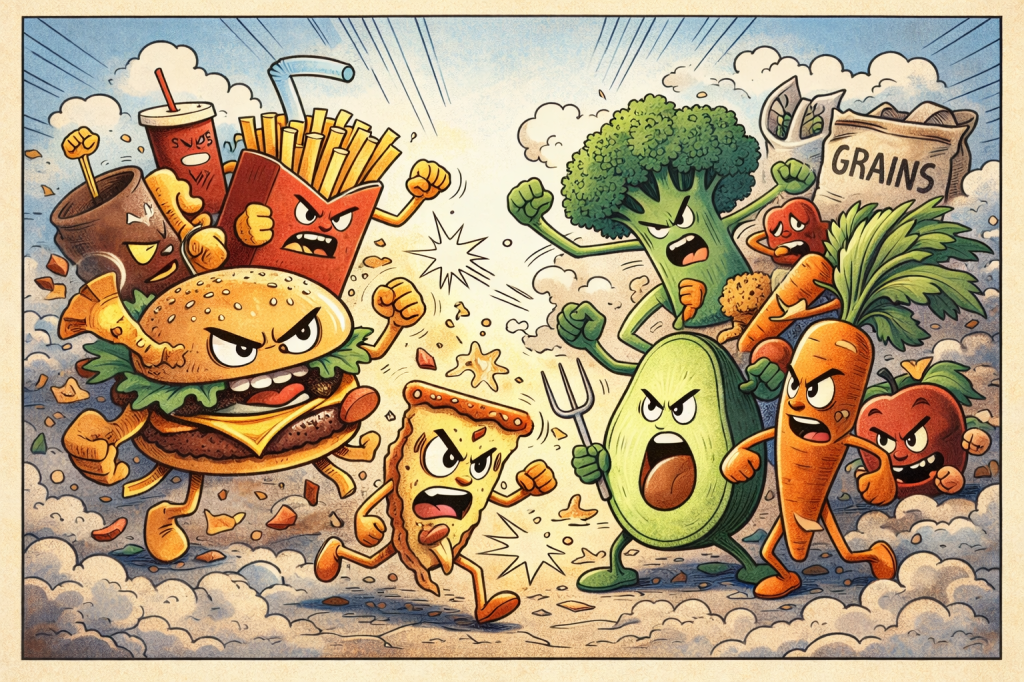
In the aisles of American grocery stores and the quiet halls of the Department of Health and Human Services (HHS), a fundamental shift is underway. Under the banner of “Make America Healthy Again” (MAHA), the federal government is attempting to dismantle decades of established nutrition and medical norms. What began as a populist health message has evolved into a sweeping regulatory project—and a political flashpoint.
The MAHA agenda is reshaping food policy, vaccine guidance, and chronic‑disease prevention at a pace that has stunned both industry and public‑health institutions. But as the reforms accelerate, so does the backlash. Far‑right political networks, corporate lobbying groups, and industry‑funded coalitions are working in parallel to slow, dilute, or discredit the movement. The result is a collision between evidence‑based prevention efforts and a political ecosystem that thrives on distrust and disruption.
The Great Food Realignment
WASHINGTON — In a sterile test kitchen inside the Food and Drug Administration (FDA) headquarters last week, technicians began the final review of a policy that would have seemed unthinkable just two years ago: the formal phasing out of all petroleum‑based food dyes in the American food supply.
The move is part of a broader 2026 regulatory slate that represents the most aggressive federal intervention in the food industry since the Nutrition Labeling and Education Act of 1990. Led by HHS Secretary Robert F. Kennedy Jr., MAHA has become a regulatory engine aimed at what he calls the “root causes of the chronic‑disease epidemic.”
At the center of the agenda is a complete overhaul of the American diet. In January, the USDA unveiled new dietary guidelines that invert the traditional food pyramid. Carbohydrates and low‑fat dairy—long staples of federal nutrition advice—are de‑emphasized in favor of “nutrient‑dense whole foods,” including meats and full‑fat dairy. The guidelines explicitly urge Americans to eliminate added sugars entirely.
“We are shifting from ‘remove the bad’ to ‘prove the good,’” said Maha Tahiri, a nutrition consultant and former industry executive. “The industry is being told that simply making a product ‘less sugary’ is no longer enough. You have to prove it’s actually food.”
These changes have energized MAHA supporters, who argue that decades of permissive regulation and industry influence have contributed to rising rates of obesity, diabetes, and autoimmune disorders. But they have also triggered a coordinated counteroffensive from corporate lobbies and far‑right political actors who see the reforms as economically disruptive—or ideologically threatening.
A House Divided on Public Health
The speed and scope of MAHA‑aligned reforms have deepened a rift in the American public and the medical establishment. Earlier this month, a KFF poll found trust in the Centers for Disease Control and Prevention (CDC) at a pandemic‑era low. The decline coincides with the administration’s controversial decision to remove several vaccines—including Hepatitis B, influenza, and COVID‑19—from the universally recommended childhood schedule.
The administration frames the move as “vaccine transparency” and a return to personal choice. Public‑health officials see something else.
“We are essentially running a massive, uncontrolled experiment on the nation’s children,” said Dr. Peter Hotez, a vaccine scientist and dean at Baylor College of Medicine. “By removing these from the recommended schedule, we aren’t just ‘providing choice’—we are dismantling the herd immunity that has kept these diseases at bay for generations.”
Far‑right influencers have seized on the vaccine changes as proof that MAHA represents a broader rejection of “elite science,” even as many of the movement’s food‑policy reforms are grounded in mainstream research. The result is a contradictory political landscape: MAHA is simultaneously championed by wellness advocates, criticized by public‑health experts, and co‑opted by far‑right networks that selectively amplify the parts of the agenda that fit their ideological narratives.
The Corporate Collision Course
The policy shifts have sent shockwaves through the $1.5 trillion U.S. food and beverage industry. Companies that once relied on “GRAS” (Generally Recognized as Safe) loopholes to introduce new additives now face a closed door. The FDA has launched “Operation Stork Speed,” a comprehensive review of infant‑formula requirements, and plans to publish new data on heavy metals like lead and arsenic in baby foods by the end of the quarter.
Industry giants are responding with a mix of quiet compliance, public‑relations campaigns, and legal threats.
“The science on some of these additives is far from settled,” said a spokesperson for a major food lobby, speaking on condition of anonymity. “To ban them overnight disrupts global supply chains and raises prices for the families this movement claims to help.”
Corporate messaging has increasingly aligned with far‑right political rhetoric, emphasizing “food freedom,” “government overreach,” and “economic harm to farmers.” These talking points obscure a more straightforward reality: MAHA threatens profit models built on ultra‑processed foods, chemical additives, and long‑term pharmaceutical dependence.
The Far‑Right Playbook: Co‑Opt, Distort, Amplify
While corporate lobbies provide the infrastructure, far‑right networks provide the amplification. Their strategy follows a familiar pattern:
- Co‑opt the language of health reform
- Distort the policy into a cultural threat
- Amplify misinformation through coordinated media ecosystems
Seed‑oil regulations become “food tyranny.” Additive bans become “attacks on American agriculture.” Vaccine‑schedule changes—ironically—are framed as proof that the government cannot be trusted on any health matter.
These narratives spread quickly in online spaces primed for distrust, complicating efforts to build consensus around evidence‑based reforms.
The Cost of Prevention
As 2026 progresses, the tension is shifting from what Americans eat to how they pay for it. The OBBBA’s removal of certain tax‑liability caps for ACA marketplace subsidies is expected to hit low‑income enrollees this spring, potentially leaving millions uninsured even as the government promotes a “healthier” lifestyle.
Critics argue that MAHA’s emphasis on personal responsibility and “toxic” ingredients risks overshadowing the structural drivers of poor health, including poverty, housing instability, and limited access to care. Proponents counter that 2026 marks the first time in decades that the federal government has challenged the “chemical‑industrial complex” that shapes the American diet.
What is certain is that the American medicine cabinet and pantry are being reorganized in real time. Whether this moment becomes a Great Recovery or a public‑health retreat will depend on whether policymakers can navigate the political, economic, and ideological forces now converging on the nation’s dinner table.


 Fact-or-Fiction Daily News
Leave a comment