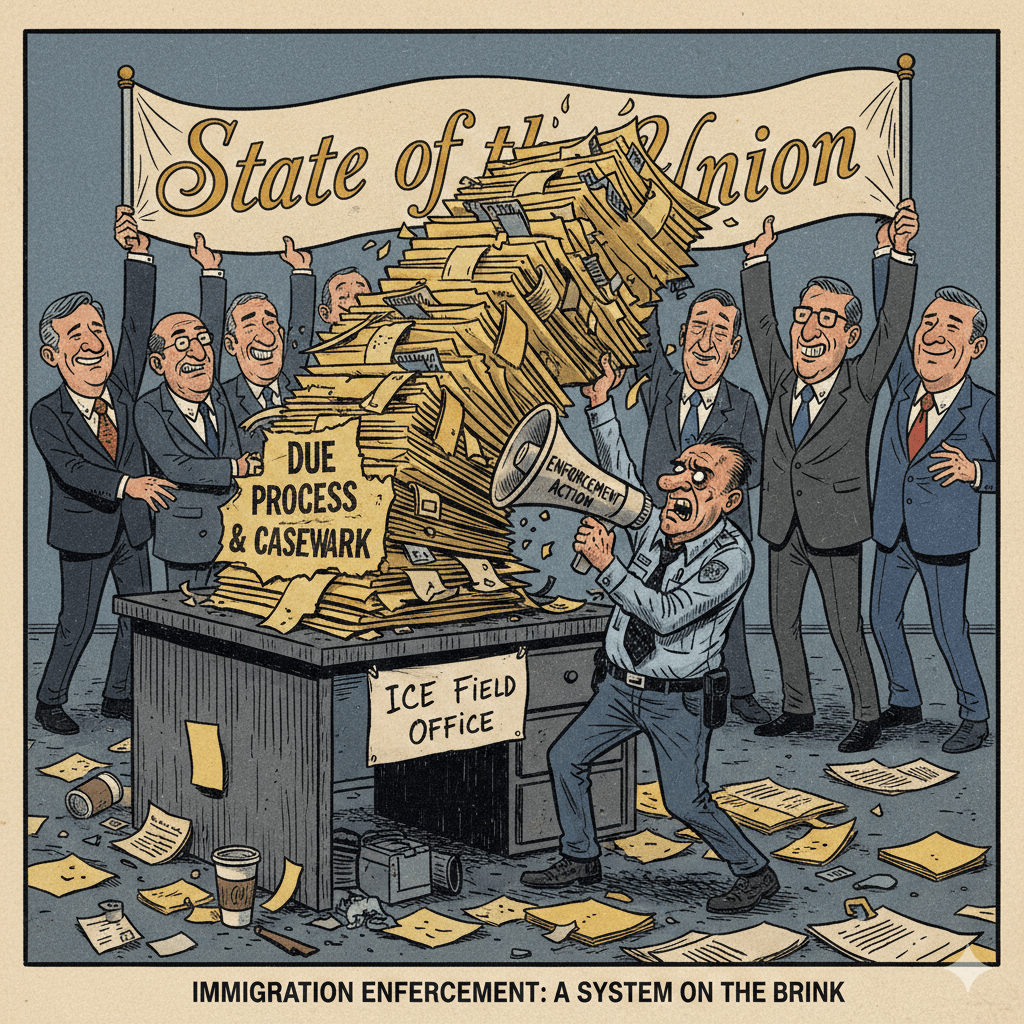
As immigration enforcement faces mounting due‑process failures, Congress has allowed DHS funding to lapse — deepening systemic problems that long predate the State of the Union.
The Department of Homeland Security is once again operating under a partial shutdown, and the consequences reach far beyond political optics. While lawmakers position themselves ahead of the State of the Union, the agencies responsible for immigration enforcement — particularly Immigration and Customs Enforcement (ICE) — are entering another period of constrained operations, delayed casework, and weakened oversight.
Shutdowns are often framed as budget disputes. Increasingly, they function as accelerants for systems already struggling to uphold due process. And in the context of immigration enforcement, the timing of this shutdown only sharpens the underlying problems.
A System Already Failing to Meet Its Own Standards
Long before the funding lapse, ICE and its partner agencies were facing significant challenges in meeting due‑process obligations. These include:
- Backlogs in immigration courts that stretch cases across years
- Delays in legal notifications, including Notices to Appear
- Inconsistent access to counsel for individuals in detention
- Limited capacity for community‑based monitoring programs
- Administrative bottlenecks that slow case reviews and appeals
A shutdown does not create these issues — it magnifies them.
When DHS funding stalls, administrative staff are furloughed, overtime budgets freeze, and support systems that underpin due‑process protections are weakened. Officers remain on duty, but the infrastructure that ensures fairness, accuracy, and accountability does not.
This is where the shutdown becomes more than a political standoff. It becomes a structural failure.
Minneapolis and Other Field Offices Are Under Heightened Pressure
Field offices such as Minneapolis — already navigating heightened community tensions and increased caseload complexity — are particularly vulnerable during funding lapses. These offices manage:
- high‑risk supervision cases
- multi‑agency coordination
- court‑ordered reporting
- community‑safety monitoring
- time‑sensitive documentation
When support staff are furloughed, these responsibilities do not pause. They simply become harder to execute with consistency and transparency.
The result is a widening gap between what the agency is required to do and what it can realistically accomplish. And that gap often falls directly on individuals navigating the immigration system, many of whom already face significant barriers to due process.
Shutdowns Don’t Halt Enforcement — They Distort It
ICE officers are considered essential personnel. They continue working without pay. But the systems that ensure due process — administrative review, legal coordination, case management, and oversight — are not fully operational during a shutdown.
This imbalance creates predictable distortions:
- Case processing slows, but enforcement actions continue
- Legal notifications lag, but deadlines remain
- Detention reviews are delayed, but detentions continue
- Court coordination weakens, but court expectations do not
In effect, shutdowns create conditions where enforcement proceeds without the full procedural framework that is supposed to accompany it.
This is not a neutral outcome. It is a structural one.
The State of the Union Will Not Address These Realities
The State of the Union is designed to project stability and direction. But delivering that message while DHS is partially unfunded highlights a contradiction: the federal government is expected to speak with authority about national security while one of its core security agencies is operating under constrained conditions.
The shutdown becomes a backdrop — but the deeper issues within immigration enforcement, including due‑process failures, will not be resolved by a single speech or a temporary funding patch.
These problems require structural reform, not political leverage.
A System Incentivized Toward Stalemate
The current shutdown reflects a broader pattern:
- Political incentives reward confrontation over compromise
- Agencies become leverage points rather than institutions
- Due‑process protections become collateral in budget disputes
- Operational strain becomes a talking point rather than a warning
ICE funding is not the cause of the shutdown. It is the leverage point.
DHS is not the intended target. It is the collateral.
Due process is not the focus. It is the casualty.
Unless Congress reforms the incentives that make shutdowns politically useful, immigration enforcement will continue to operate in cycles of instability — cycles that undermine both public trust and procedural fairness.


 Fact-or-Fiction Daily News
Leave a comment