The House Judiciary hearing on the Epstein Files Act exposed a DOJ more focused on protecting elites than safeguarding survivors — and more loyal to political narratives than the rule of law
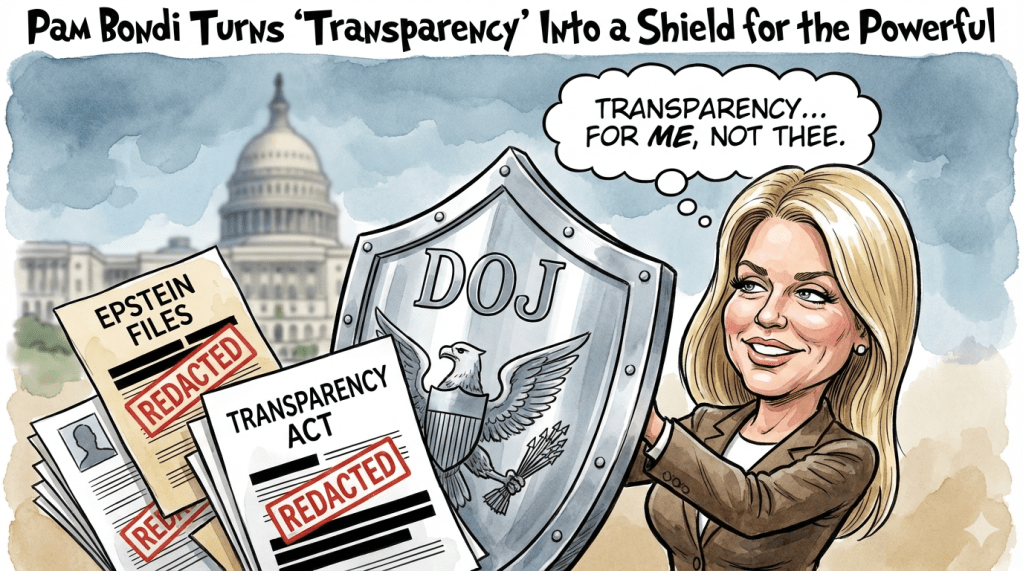
WASHINGTON — During the five‑hour spectacle of the House Judiciary Committee on February 11, 2026, Attorney General Pam Bondi didn’t simply defend the Department of Justice — she fortified it behind a partisan shield thick enough to deflect both victims and facts. What was supposed to be an oversight hearing on the Epstein Files Transparency Act instead became a case study in how a modern bureaucracy can turn “transparency” into a tool for hiding the truth.
The irony was unmistakable: a law meant to expose the powerful and protect the vulnerable was, under Bondi’s direction, used to protect the powerful and expose the vulnerable.
Bondi’s main argument was the “Time Pressure” defense — claiming that the 30‑day deadline to release 3 million pages made clerical mistakes inevitable. But a closer look at the redactions shows a pattern, not an accident.
The Elite Shield
Investigators found that names of high‑profile associates — including former Victoria’s Secret CEO Les Wexner — were initially redacted in documents where they appeared as potential co‑conspirators. Bondi insisted these names were restored “within 40 minutes.” Rep. Thomas Massie (R‑KY) corrected her: they were restored only after the DOJ was “caught red‑handed.”
While elite names received careful (if temporary) protection, the DOJ failed to redact the identities and sensitive photographs of dozens of survivors who had never gone public. The DOJ’s 500 attorneys had the time to shield the wealthy — but not the time, or the will, to protect the people Epstein harmed.
The Massie‑Bondi Collision: When the Script Broke
The most revealing moment came from a Republican, not a Democrat. Rep. Thomas Massie, one of the authors of the transparency law, broke ranks and challenged Bondi directly.
“You are responsible,” Massie said, pointing to the unredacted victim data. “Are you able to track who in the organization made this massive failure?”
Bondi didn’t offer a legal explanation. Instead, she launched a political attack, accusing Massie — a conservative ally — of having “Trump Derangement Syndrome” and calling him a “hypocrite.” By dismissing a legitimate oversight question with a campaign‑trail insult, Bondi signaled that loyalty to the executive now outweighs loyalty to the law.
The 15 Silent Answers
Across the hearing, Bondi dodged or deflected 15 core questions — each central to the Epstein case and to the DOJ’s credibility. Her refusal to answer sets a dangerous precedent for future oversight.
On Accountability
She would not say whether anyone at the DOJ would face consequences for exposing survivors’ identities.
On Investigation
She refused to confirm whether the DOJ is investigating the co‑conspirator leads restored in the Wexner files.
On Empathy
She declined to apologize to the 11 survivors seated behind her, calling the request “gutter theatrics.”
The Final Verdict: Justice as an Arm of Authoritarianism
The hearing revealed a Department of Justice that now behaves less like an independent institution and more like a private law firm for the administration. Bondi dismissed constitutional law professors as “loser lawyers” and grieving survivors as “theatrics,” replacing the blindfold of justice with a partisan badge.
The outcome wasn’t a stalemate — it was a surrender. The “Epstein Cover‑Up” is no longer a fringe theory. It is an administrative process in which redaction pens shield the elite and cut into the victims.


 Fact-or-Fiction Daily News
Leave a comment